AI Coding Conventions: Which Format Wins in 2026?
Choosing the right AI coding conventions in 2026 is no longer a style preference; it decides how well every agent on your team performs. Three formats dominate the conversation: Anthropic's CLAUDE.md, Cursor's .cursorrules, and the cross-tool AGENTS.md standard. However, the real winner is not a single file at all. It is a routed, portable skill system that survives tool churn. This guide compares the contenders with real data, then shows why routing beats a flat rules blob.
Which AI coding conventions win in 2026?
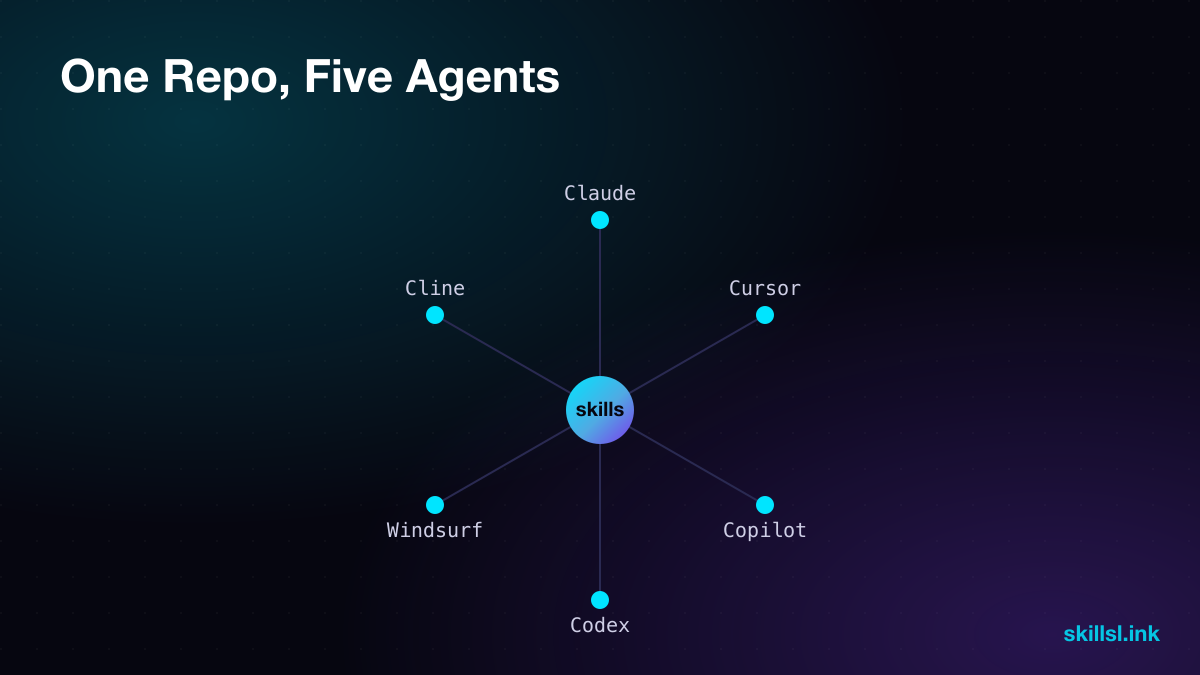
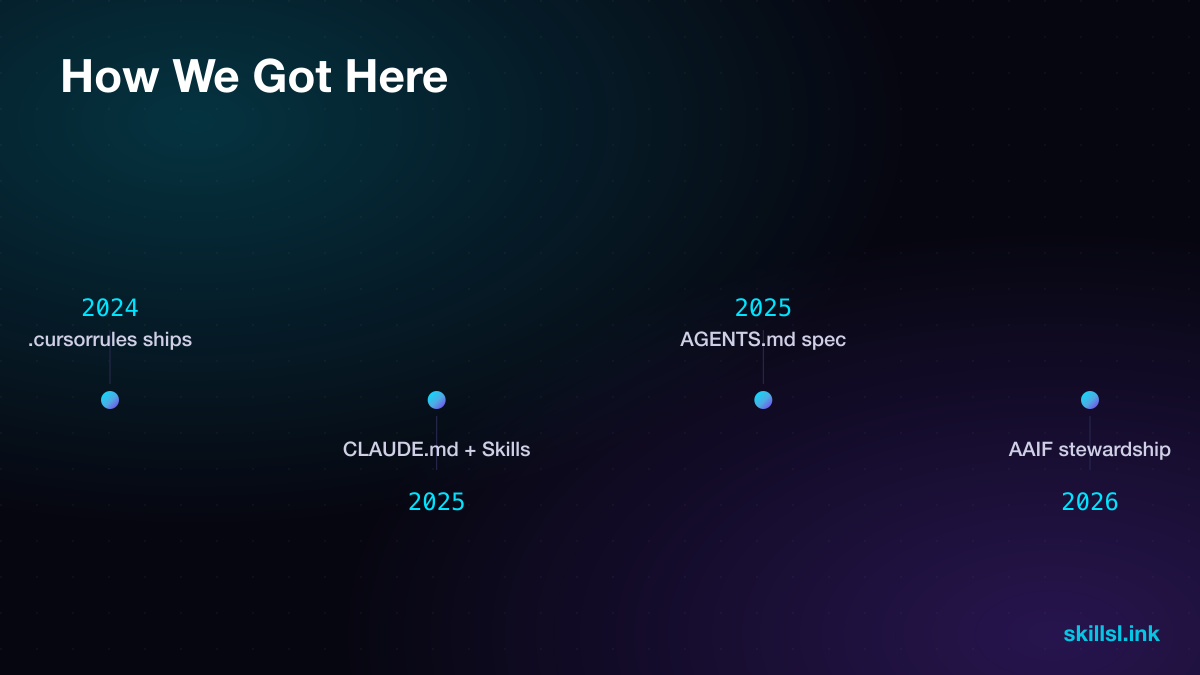
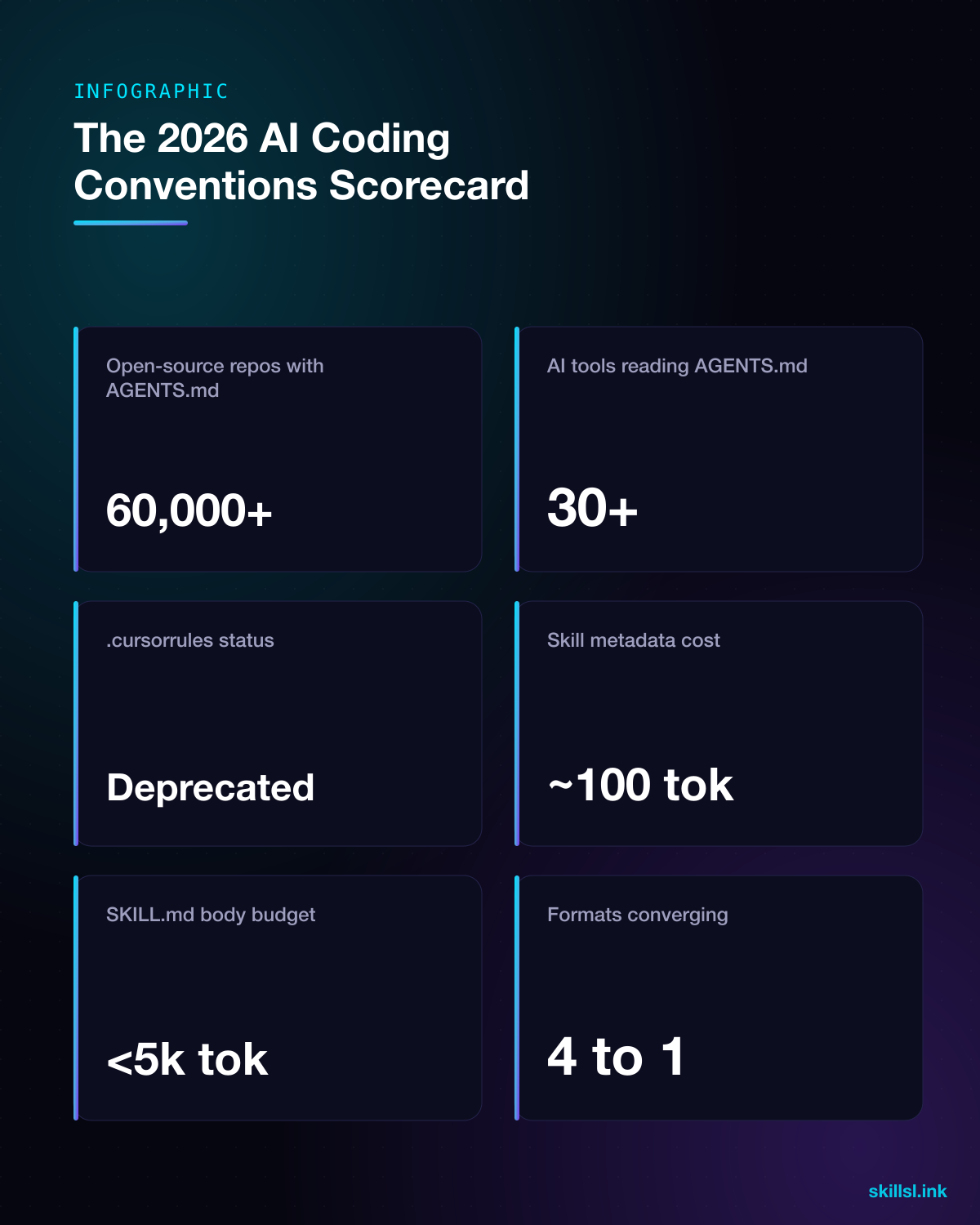
AGENTS.md wins as the shared baseline, because over 30 agents read it and 60,000+ repos already ship it. However, the smarter pattern layers a routed skill system on top. Write AGENTS.md once, point every tool-specific file at it, and let small skills load on demand. Portability, not any single vendor file, decides which AI coding conventions actually win.
The three contenders, briefly
Each format solves the same problem differently. Therefore, understanding their origins clarifies the trade-offs. All three are, at heart, AI coding conventions: files that tell an agent how to build, test, and style your code.
- CLAUDE.md is Anthropic's primary instruction file for Claude Code. It holds persistent engineering conventions and loads at session start.
- .cursorrules was Cursor's original single-file rules format. However, Cursor deprecated it in favor of
.cursor/rules/directories with per-rule frontmatter. - AGENTS.md is the open, tool-agnostic standard. Meanwhile, it reads like a "README for agents" and lives at the repo root.
How adoption actually breaks down
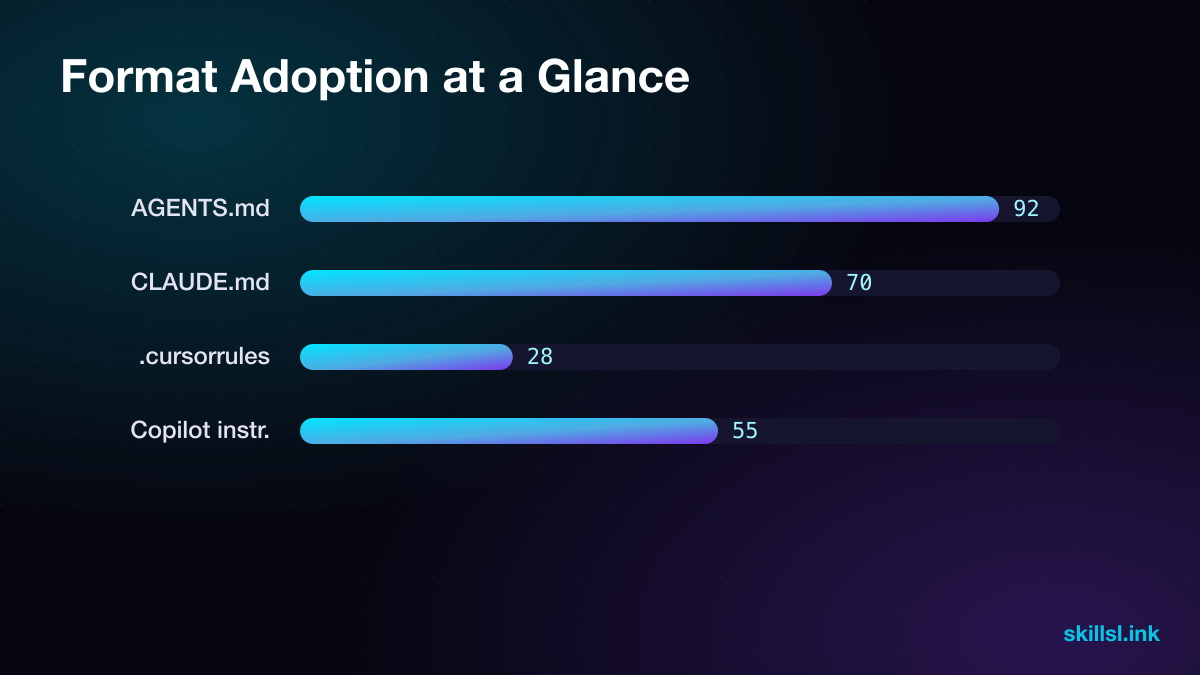
Adoption numbers tell a clear story. The AGENTS.md project reports use across more than 60,000 open-source repositories, read by 25+ tools including Codex, Cursor, Copilot, Jules, and Aider. As a result, it is the closest thing the industry has to a universal format.
Cursor, in contrast, moved on from its own invention. According to Cursor's documentation, .cursorrules still loads for backward compatibility, yet it receives no new features. New rules now live in .cursor/rules/ as .mdc files with globs and activation modes. Therefore, treat the old single file as read-only legacy.
GitHub took a third path. Copilot reads a repository-wide .github/copilot-instructions.md plus path-specific *.instructions.md files that scope rules by glob, as documented in the GitHub Copilot docs. Anthropic, meanwhile, keeps CLAUDE.md as the Claude Code default while importing AGENTS.md when present. In other words, the market is quietly consolidating its AI coding conventions around one shared file.
AI coding conventions compared head-to-head
Features matter less than fit. Below, we score each format on the axes that predict long-term value. Notably, portability and routing carry the most weight, because tools change far faster than codebases.
| Format | Portability | Structure | Routing | Tooling |
|---|---|---|---|---|
| AGENTS.md | Excellent | Flat Markdown | Hierarchical by folder | 30+ agents |
| CLAUDE.md | Good (imports AGENTS.md) | Flat Markdown | Manual sections | Claude ecosystem |
| .cursorrules | Poor (legacy) | Single file | None | Cursor only |
| Copilot instructions | Moderate | Markdown + globs | Path-scoped | Copilot surfaces |
The pattern jumps out immediately. Single-vendor files score well inside their home tool, yet they strand you the moment you switch agents. In contrast, AGENTS.md travels everywhere, which is why its momentum keeps compounding. However, even AGENTS.md shares one weakness with the rest: it is still a flat file.
Why a flat rules file eventually breaks
A flat instruction file feels tidy at first. Then it grows. Every new rule, framework note, and security caveat piles into one blob that the agent must read on every request. As a result, three problems compound.
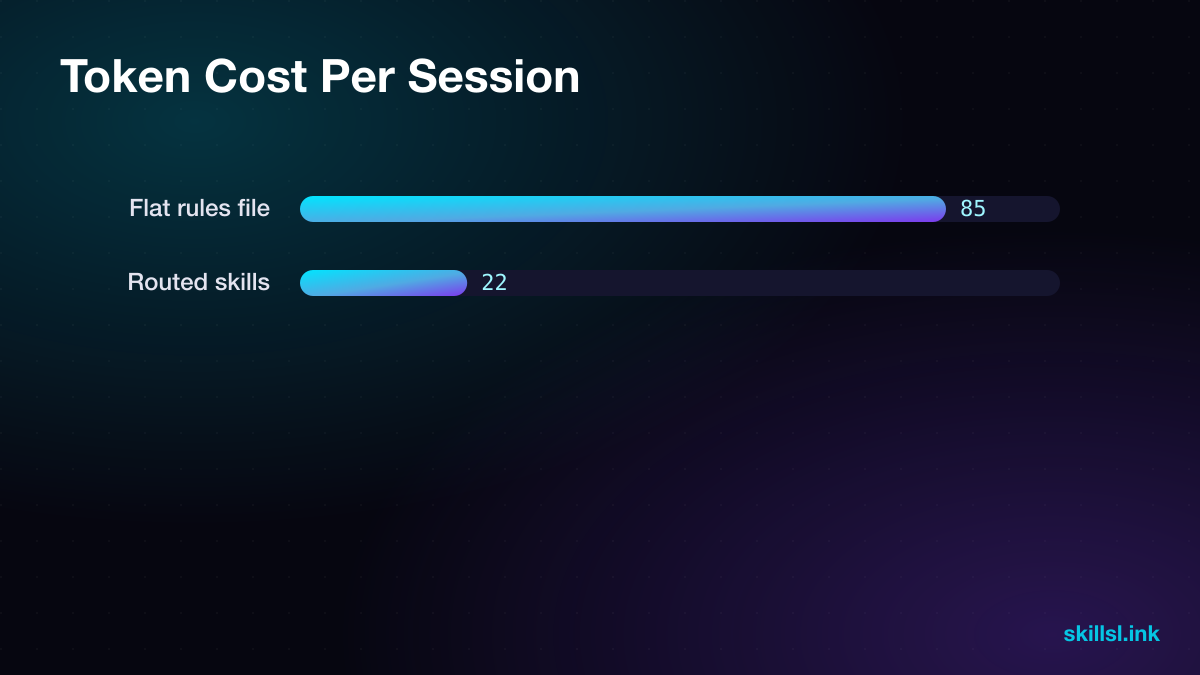
- Context bloat. The agent loads all rules even when a task touches one tiny area. Therefore, tokens and attention get wasted.
- Rule collisions. Backend and frontend guidance sit side by side, so the agent applies the wrong convention to the wrong file.
- No triggering. A flat file cannot say "only load the payments rules when editing payments." Consequently, relevance drops as the file grows.
Path-specific Copilot files and Cursor's .mdc globs patch the triggering gap. Still, they stop at file-path matching. They do not reason about the task itself. Consequently, a flat instruction file hits a ceiling the moment a repo grows past a few domains.
Why routed AI coding conventions win
This is where a routed skill system pulls ahead. Anthropic's Agent Skills package instructions into folders, each with a SKILL.md that declares a name and description. Claude reads only that metadata at startup. Then, when a task matches, it loads the full skill. Anthropic calls this progressive disclosure.
The efficiency gain is dramatic. Metadata costs roughly 100 tokens per skill, while the full body stays under 5,000 tokens and loads only on demand. Therefore, you can keep dozens of skills on hand without drowning the context window. A flat file simply cannot match that economy.
Routing also fixes rule collisions. Because each skill owns one category, the agent pulls payments guidance for payments work and testing guidance for tests. Meanwhile, the selection happens through the model's own reasoning, not brittle keyword matching. As a result, routed AI coding conventions behave less like a config file and more like an on-call senior engineer who knows exactly which playbook to open. In practice, that difference shows up as fewer wrong-context edits and tighter diffs.
Routing plus the open standard
Crucially, skills follow an open standard, so the same SKILL.md runs across the Claude API, Claude Code, and other agents. As a result, routing and portability stop being a trade-off. You get both at once. That combination is exactly what a cross-tool skills OS delivers, and why we built our platform around it.
Portability is now the deciding factor
Here is the uncomfortable truth. Your favorite agent in 2026 may not be your favorite in 2027. Tools churn, pricing shifts, and new models arrive monthly. Therefore, betting your conventions on one vendor's file is a fragile strategy.
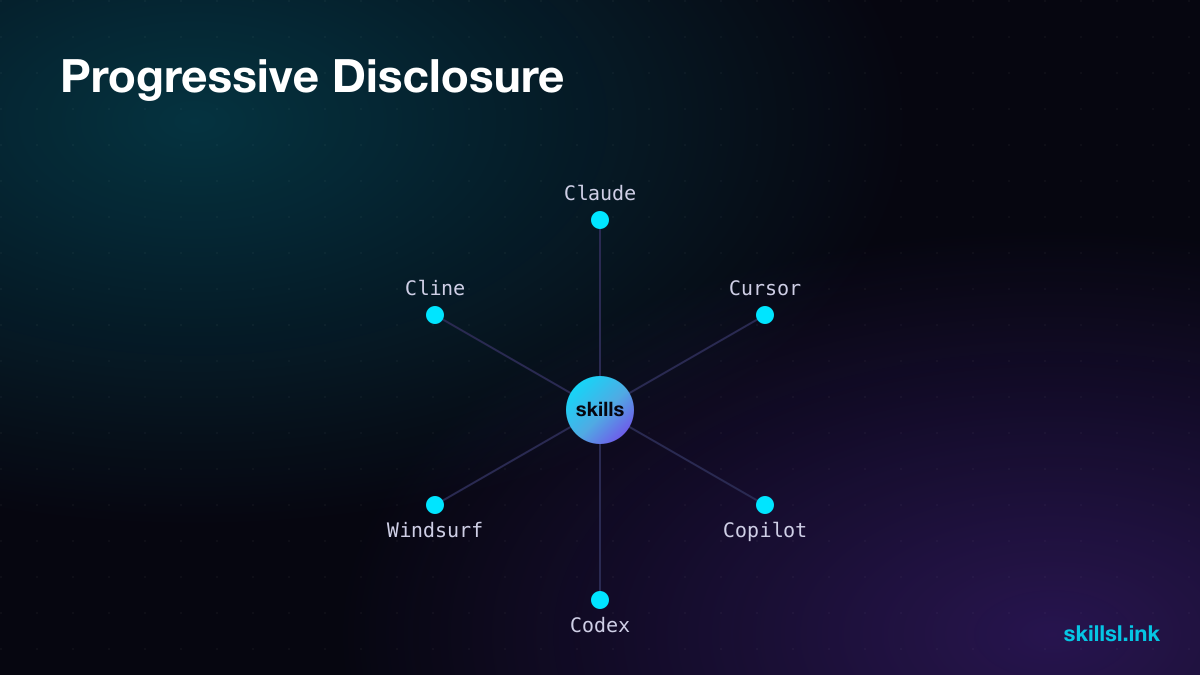
The durable move is to decouple knowledge from the tool. Write AGENTS.md as your canonical source, then let CLAUDE.md, .cursorrules, and Copilot files point back to it. Above that baseline, layer routed skills that any compliant agent can read. Consequently, switching tools becomes a config change, not a rewrite.
Our on-site skills-profile comparison makes this concrete. You can see which of the 32+ supported platforms read which conventions, then export a portable profile that travels with you. Because the skills are routed and standard-based, they degrade gracefully even on tools that only understand a flat file.
The verdict
So which format wins? For a shared baseline, AGENTS.md wins outright, and its Agentic AI Foundation stewardship under the Linux Foundation signals it will outlast any single vendor. However, the format war misses the bigger shift. The winning move in 2026 is architectural, not textual.
Pick AGENTS.md as your floor. Keep CLAUDE.md and friends as thin pointers. Then invest your real effort in routed, multi-category skills that load on demand and travel across every agent. That approach beats a flat rules file on tokens, on relevance, and on resilience. In short, the AI coding conventions that actually win in 2026 pair a portable baseline with on-demand routing.
Ready to make your conventions portable? Explore the platform at skillsl.ink and build a skills profile that works across every AI coding tool you use today, and every one you adopt next.
Build with the system behind this post
Agent Skills makes every AI coding tool ship production-grade work from one-line prompts.
Get Agent Skills ↗